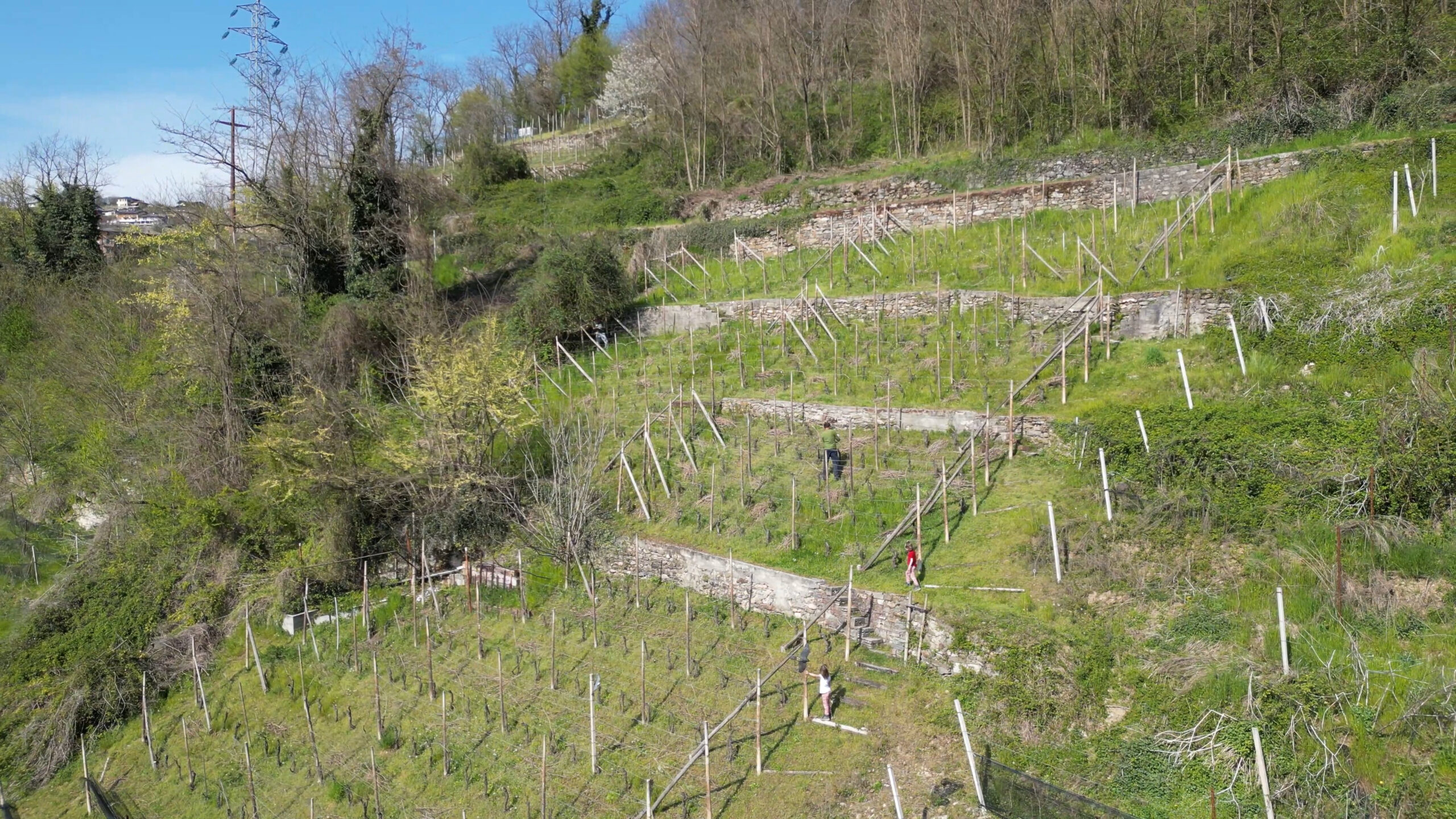

The steep slopes descending from the top of Colle di Tenna to the shores of Lake Caldonazzo, in the area known as “Le Terrazze”, reach gradients ranging between 20% and 40%. The exposure to south/south-west, the altitude of about 450 meters above sea level, and the tempered breeze from the lake that flows along the side of the hill are excellent conditions for the maturation of Pinot Nero grapes, destined for red wine vinification.

Also in the area known as “Le Terrazze”, overlooking Lake Caldonazzo, lie the “Fontanaze” vineyard plots. The name originates from the presence of small surface springs — “fontane” — which allow the roots to delve into moist, nutrient-rich soil. The upper section of the terrain is extremely steep, requiring manual harvesting and vineyard management.
On the terraced slopes featuring progressive dry-stone walls, facing south/south-west at an altitude of about 530 meters above sea level, I grow Riesling Renano from very old vines (over 40 years). The mineral-rich soil, the ideal exposure, and the sunlight reflected from the surface of Lake Caldonazzo ensure a full, rounded ripening of the Riesling grapes.

At a lower elevation — around 450 meters above sea level — the slopes become slightly less steep as they descend toward Lake Caldonazzo. These plots were once uncultivated and left to forest encroachment until only a few years ago. Today, they have finally been restored to vine cultivation, in keeping with the century-old tradition of the Colle di Tenna.
The reclamation, which required tremendous effort (considering the inaccessibility for heavy machinery and the steep gradient), is still ongoing, as each year I continue the complex recovery of new parcels to expand grape production. The unique stratigraphic characteristics, combined with the historical and symbolic value of these lands, make them well suited to the cultivation of Chardonnay grapes for sparkling wine base.
From the hand cultivation of these grapes came my first Metodo Classico — a pure Trentodoc Extra Brut, aged 30 months on the lees.